
Mit der Objektlokalisierung der Vision API lassen sich mehrere Objekte in einem Bild erkennen und extrahieren.
Die Objektlokalisierung kann in einem Bild mehrere Objekte identifizieren und eine LocalizedObjectAnnotation für jedes Objekt im Bild bereitstellen. Mit jeder LocalizedObjectAnnotation lassen sich Informationen über das Objekt, die Position des Objekts und die rechteckigen Begrenzungen für den Bereich des Bildes ermitteln, in dem sich das Objekt befindet.
Die Objektlokalisierung identifiziert sowohl wichtige als auch weniger wichtige Objekte in einem Bild.
Objektinformationen werden nur auf Englisch zurückgegeben. Mit Cloud Translation lassen sich englische Labels in verschiedene Sprachen übersetzen.
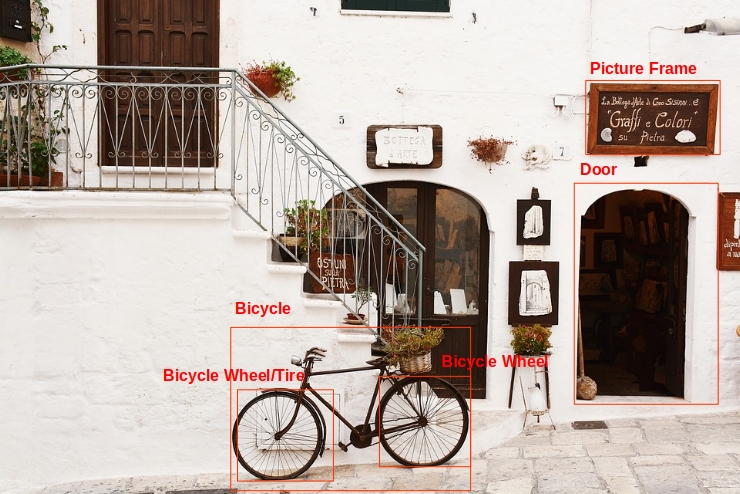
Die API gibt beispielsweise die folgenden Informationen und Begrenzungsstandortdaten für die Objekte im vorherigen Bild zurück:
| Name | mid | Bewertung | Grenzwerte |
|---|---|---|---|
| Laufrad | /m/01bqk0 | 0,89648587 | (0,32076266, 0,78941387), (0,43812272, 0,78941387), (0,43812272, 0,97331065), (0,32076266, 0,97331065) |
| Fahrrad | /m/0199g | 0,886761 | (0,312, 0,6616471), (0,638353, 0,6616471), (0,638353, 0,9705882), (0,312, 0,9705882) |
| Laufrad | /m/01bqk0 | 0,6345275 | (0,5125398, 0,760708), (0,6256646, 0,760708), (0,6256646, 0,94601655), (0,5125398, 0,94601655) |
| Bilderrahmen | /m/06z37_ | 0,6207608 | (0,79177403, 0,16160682), (0,97047985, 0,16160682), (0,97047985, 0,31348917), (0,79177403, 0,31348917) |
| Reifen | /m/0h9mv | 0,55886006 | (0,32076266, 0,78941387), (0,43812272, 0,78941387), (0,43812272, 0,97331065), (0,32076266, 0,97331065) |
| Tür | /m/02dgv | 0,5160098 | (0,77569866, 0,37104446), (0,9412425, 0,37104446), (0,9412425, 0,81507325), (0,77569866, 0,81507325) |
mid enthält die maschinengenerierte Kennzeichnung (Machine-generated Identifier, MID), die dem Google Knowledge Graph-Eintrag des Labels entspricht. Weitere Informationen zur Untersuchung dieser MID-Werte finden Sie in der Dokumentation zur Google Knowledge Graph Search API.
Objektlokalisierungsanfragen
Google Cloud -Projekt und Authentifizierung einrichten
Wenn Sie noch kein Google Cloud Projekt erstellt haben, tun Sie dies jetzt. Maximieren Sie diesen Abschnitt, um die Anleitung einzublenden.
-
In the Google Cloud console, on the project selector page, select or create a Google Cloud project.
Roles required to select or create a project
- Select a project: Selecting a project doesn't require a specific IAM role—you can select any project that you've been granted a role on.
-
Create a project: To create a project, you need the Project Creator
(
roles/resourcemanager.projectCreator), which contains theresourcemanager.projects.createpermission. Learn how to grant roles.
-
Verify that billing is enabled for your Google Cloud project.
-
Enable the Vision API.
Roles required to enable APIs
To enable APIs, you need the Service Usage Admin IAM role (
roles/serviceusage.serviceUsageAdmin), which contains theserviceusage.services.enablepermission. Learn how to grant roles. -
Install the Google Cloud CLI.
-
Konfigurieren Sie die gcloud CLI für die Verwendung Ihrer föderierten Identität.
Weitere Informationen finden Sie unter Mit Ihrer föderierten Identität in der gcloud CLI anmelden.
-
Führen Sie folgenden Befehl aus, um die gcloud CLI zu initialisieren:
gcloud initObjekte in einem lokalen Bild erkennen
Sie können die Vision API für die Erkennung von Features in einer lokalen Bilddatei verwenden.
Senden Sie bei REST-Anfragen den Inhalt der Bilddatei als base64-codierten String im Text Ihrer Anfrage.
Geben Sie für Anfragen mit
gcloudund Clientbibliotheken den Pfad zu einem lokalen Bild in Ihrer Anfrage an.REST
Ersetzen Sie folgende Werte in den Anfragedaten:
- BASE64_ENCODED_IMAGE: die Base64-Darstellung (ASCII-String) der Binärbilddaten. Dieser String sollte in etwa so aussehen:
/9j/4QAYRXhpZgAA...9tAVx/zDQDlGxn//2Q==
- RESULTS_INT: (optional) ein ganzzahliger Wert der Ergebnisse, die zurückgegeben werden sollen. Wenn Sie das Feld
"maxResults"und seinen Wert weglassen, gibt die API den Standardwert von 10 Ergebnissen zurück. Dieses Feld gilt nicht für die folgenden Featuretypen:TEXT_DETECTION,DOCUMENT_TEXT_DETECTIONoderCROP_HINTS. - PROJECT_ID: Ihre Google Cloud Projekt-ID
HTTP-Methode und URL:
POST https://vision.googleapis.com/v1/images:annotate
JSON-Text der Anfrage:
{
  "requests": [
    {
      "image": {
        "content": "BASE64_ENCODED_IMAGE"
      },
      "features": [
        {
          "maxResults": RESULTS_INT,
          "type": "OBJECT_LOCALIZATION"
        },
      ]
    }
  ]
}
Wenn Sie die Anfrage senden möchten, wählen Sie eine der folgenden Optionen aus:
curl
Speichern Sie den Anfragetext in einer Datei mit dem Namen
request.jsonund führen Sie den folgenden Befehl aus:curl -X POST \
-H "Authorization: Bearer $(gcloud auth print-access-token)" \
-H "x-goog-user-project: PROJECT_ID" \
-H "Content-Type: application/json; charset=utf-8" \
-d @request.json \
"https://vision.googleapis.com/v1/images:annotate"PowerShell
Speichern Sie den Anfragetext in einer Datei mit dem Namen
request.jsonund führen Sie den folgenden Befehl aus:$cred = gcloud auth print-access-token
$headers = @{ "Authorization" = "Bearer $cred"; "x-goog-user-project" = "PROJECT_ID" }
Invoke-WebRequest `
-Method POST `
-Headers $headers `
-ContentType: "application/json; charset=utf-8" `
-InFile request.json `
-Uri "https://vision.googleapis.com/v1/images:annotate" | Select-Object -Expand ContentWenn die Anfrage erfolgreich ist, gibt der Server den HTTP-Statuscode
200 OKund die Antwort im JSON-Format zurück.Antwort:
Go
Bevor Sie dieses Beispiel ausprobieren, folgen Sie der Go-Einrichtungsanleitung in der Vision-Kurzanleitung zur Verwendung von Clientbibliotheken. Weitere Informationen finden Sie in der Go-Referenzdokumentation zur Vision API.
Richten Sie zur Authentifizierung bei Vision die Standardanmeldedaten für Anwendungen (ADC) ein. Weitere Informationen finden Sie unter ADC für eine lokale Entwicklungsumgebung einrichten.
Java
Bevor Sie dieses Beispiel ausprobieren, folgen Sie der Einrichtungsanleitung für Java in der Vision API-Kurzanleitung zur Verwendung von Clientbibliotheken. Weitere Informationen finden Sie in der Java-Referenzdokumentation zur Vision API.
Node.js
Bevor Sie dieses Beispiel ausprobieren, folgen Sie der Einrichtungsanleitung für Node.js in der Vision-Kurzanleitung zur Verwendung von Clientbibliotheken. Weitere Informationen finden Sie in der Node.js-Referenzdokumentation zur Vision API.
Richten Sie zur Authentifizierung bei Vision die Standardanmeldedaten für Anwendungen (ADC) ein. Weitere Informationen finden Sie unter ADC für eine lokale Entwicklungsumgebung einrichten.
Python
Bevor Sie dieses Beispiel ausprobieren, folgen Sie der Einrichtungsanleitung für Python in der Vision-Kurzanleitung zur Verwendung von Clientbibliotheken. Weitere Informationen finden Sie in der Python-Referenzdokumentation zur Vision API.
Richten Sie zur Authentifizierung bei Vision die Standardanmeldedaten für Anwendungen (ADC) ein. Weitere Informationen finden Sie unter ADC für eine lokale Entwicklungsumgebung einrichten.
Weitere Sprachen
C#: Folgen Sie der Einrichtungsanleitung für C# auf der Seite der Clientbibliotheken und rufen Sie dann die Vision-Referenzdokumentation für .NET auf.
PHP: Folgen Sie der Einrichtungsanleitung für PHP auf der Seite der Clientbibliotheken und rufen Sie dann die Vision-Referenzdokumentation für PHP auf.
Ruby: Folgen Sie der Anleitung zum Einrichten von Ruby auf der Seite der Clientbibliotheken und rufen Sie dann die Vision-Referenzdokumentation für Ruby auf.
Objekte in einem Remote-Bild erkennen
Sie können die Vision API für die Erkennung von Features in einer Remote-Bilddatei verwenden, die sich in Cloud Storage oder im Web befindet. Zum Senden einer Remote-Dateianfrage geben Sie die URL oder den Cloud Storage-URI der Datei im Anfragetext an.
REST
Ersetzen Sie folgende Werte in den Anfragedaten:
- CLOUD_STORAGE_IMAGE_URI: der Pfad zu einer gültigen Bilddatei in einem Cloud Storage-Bucket. Sie müssen zumindest Leseberechtigungen für die Datei haben.
Beispiel:
https://cloud.google.com/vision/docs/images/bicycle_example.png
- RESULTS_INT: (optional) ein ganzzahliger Wert der Ergebnisse, die zurückgegeben werden sollen. Wenn Sie das Feld
"maxResults"und seinen Wert weglassen, gibt die API den Standardwert von 10 Ergebnissen zurück. Dieses Feld gilt nicht für die folgenden Featuretypen:TEXT_DETECTION,DOCUMENT_TEXT_DETECTIONoderCROP_HINTS. - PROJECT_ID: Ihre Google Cloud Projekt-ID
HTTP-Methode und URL:
POST https://vision.googleapis.com/v1/images:annotate
JSON-Text der Anfrage:
{
  "requests": [
    {
      "image": {
        "source": {
          "imageUri": "CLOUD_STORAGE_IMAGE_URI"
        }
      },
      "features": [
        {
          "maxResults": RESULTS_INT,
          "type": "OBJECT_LOCALIZATION"
        },
      ]
    }
  ]
}
Wenn Sie die Anfrage senden möchten, wählen Sie eine der folgenden Optionen aus:
curl
Speichern Sie den Anfragetext in einer Datei mit dem Namen
request.jsonund führen Sie den folgenden Befehl aus:curl -X POST \
-H "Authorization: Bearer $(gcloud auth print-access-token)" \
-H "x-goog-user-project: PROJECT_ID" \
-H "Content-Type: application/json; charset=utf-8" \
-d @request.json \
"https://vision.googleapis.com/v1/images:annotate"PowerShell
Speichern Sie den Anfragetext in einer Datei mit dem Namen
request.jsonund führen Sie den folgenden Befehl aus:$cred = gcloud auth print-access-token
$headers = @{ "Authorization" = "Bearer $cred"; "x-goog-user-project" = "PROJECT_ID" }
Invoke-WebRequest `
-Method POST `
-Headers $headers `
-ContentType: "application/json; charset=utf-8" `
-InFile request.json `
-Uri "https://vision.googleapis.com/v1/images:annotate" | Select-Object -Expand ContentWenn die Anfrage erfolgreich ist, gibt der Server den HTTP-Statuscode
200 OKund die Antwort im JSON-Format zurück.Antwort:
Go
Bevor Sie dieses Beispiel ausprobieren, folgen Sie der Go-Einrichtungsanleitung in der Vision-Kurzanleitung zur Verwendung von Clientbibliotheken. Weitere Informationen finden Sie in der Go-Referenzdokumentation zur Vision API.
Richten Sie zur Authentifizierung bei Vision die Standardanmeldedaten für Anwendungen (ADC) ein. Weitere Informationen finden Sie unter ADC für eine lokale Entwicklungsumgebung einrichten.
Java
Bevor Sie dieses Beispiel ausprobieren, folgen Sie der Einrichtungsanleitung für Java in der Vision API-Kurzanleitung zur Verwendung von Clientbibliotheken. Weitere Informationen finden Sie in der Java-Referenzdokumentation zur Vision API.
Node.js
Bevor Sie dieses Beispiel ausprobieren, folgen Sie der Einrichtungsanleitung für Node.js in der Vision-Kurzanleitung zur Verwendung von Clientbibliotheken. Weitere Informationen finden Sie in der Node.js-Referenzdokumentation zur Vision API.
Richten Sie zur Authentifizierung bei Vision die Standardanmeldedaten für Anwendungen (ADC) ein. Weitere Informationen finden Sie unter ADC für eine lokale Entwicklungsumgebung einrichten.
Python
Bevor Sie dieses Beispiel ausprobieren, folgen Sie der Einrichtungsanleitung für Python in der Vision-Kurzanleitung zur Verwendung von Clientbibliotheken. Weitere Informationen finden Sie in der Python-Referenzdokumentation zur Vision API.
Richten Sie zur Authentifizierung bei Vision die Standardanmeldedaten für Anwendungen (ADC) ein. Weitere Informationen finden Sie unter ADC für eine lokale Entwicklungsumgebung einrichten.
gcloud
Verwenden Sie für die Erkennung von Labels in einem Bild den Befehl
gcloud ml vision detect-objects, wie im folgenden Beispiel gezeigt:gcloud ml vision detect-objects https://cloud.google.com/vision/docs/images/bicycle_example.png
Weitere Sprachen
C#: Folgen Sie der Einrichtungsanleitung für C# auf der Seite der Clientbibliotheken und rufen Sie dann die Vision-Referenzdokumentation für .NET auf.
PHP: Folgen Sie der Einrichtungsanleitung für PHP auf der Seite der Clientbibliotheken und rufen Sie dann die Vision-Referenzdokumentation für PHP auf.
Ruby: Folgen Sie der Einrichtungsanleitung für Ruby auf der Seite der Clientbibliotheken und rufen Sie dann die Vision-Referenzdokumentation für Ruby auf.
Jetzt testen
Probieren Sie die Objekterkennung und ‑lokalisierung mit dem folgenden Tool aus. Sie können das bereits angegebene Bild verwenden (
https://cloud.google.com/vision/docs/images/bicycle_example.png) oder stattdessen ein eigenes Bild angeben. Wählen Sie zum Senden der Anfrage Ausführen aus.
Bildnachweis: Bogdan Dada auf Unsplash. Anfragetext:
{ "requests": [ { "features": [ { "maxResults": 10, "type": "OBJECT_LOCALIZATION" } ], "image": { "source": { "imageUri": "https://cloud.google.com/vision/docs/images/bicycle_example.png" } } } ] } - BASE64_ENCODED_IMAGE: die Base64-Darstellung (ASCII-String) der Binärbilddaten. Dieser String sollte in etwa so aussehen: